
Business travel has its own optimization problem, distinct from vacation travel or family travel. The traveler is going to a specific meeting on a specific day, needs to arrive rested and functional, needs their bag with them at the destination, and typically has a much lower tolerance for the small failures that a vacation traveler might shrug off. A missed connection is not a story to tell later; it is a missed meeting that has real consequences.
The habits of professional business travelers — people who fly 100 or more times a year for work — have converged on a specific set of practices that are boring individually and decisive in aggregate. This article is a walk through what those practices are and why they work. Most of them are unglamorous. All of them compound if you fly frequently.
Pack the same bag the same way every time
The single most consequential habit of the frequent business traveler is that they pack the same bag the same way for every trip. Different bag for a three-day trip versus a week-long trip, but the internal organization is identical. Toiletries in the same pouch in the same pocket. Chargers in the same organizer in the same slot. Documents in the same folder in the same compartment. This is not fastidiousness; it is efficiency.
The reason this matters is that packing time compresses from thirty or forty minutes to five or six when the pattern is fixed. You never have to think about whether you brought your charger; you look at the slot where the charger lives and confirm. You never have to hunt through your suitcase for your medication; you know it lives in the front left pocket of the toiletries pouch. The mental overhead of packing goes to nearly zero, and the error rate falls dramatically.
This habit only develops if you set it up deliberately. Buy the right organizers once, decide where each category of item lives, and then never change the pattern. The first few trips feel constrained; after a dozen trips, it feels obvious. The freedom of not thinking about packing is one of the underrated benefits of business travel done well.
Carry-on only, aggressively

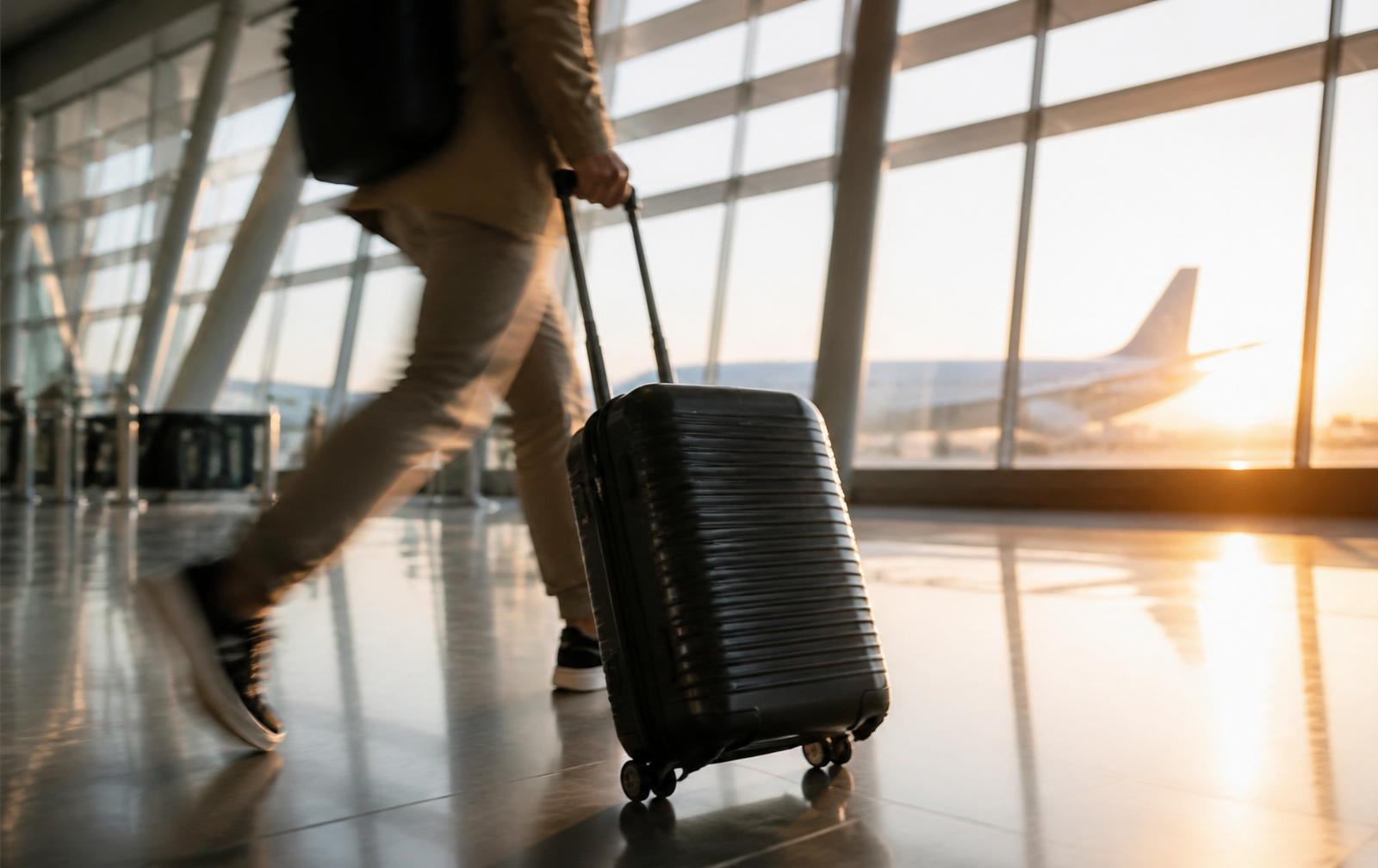
The frequent business traveler almost never checks a bag. This is not a stylistic preference; it is an operational decision. Checked bags introduce risk that is entirely avoidable — lost bag risk, delayed bag risk, waiting-at-baggage-claim time — and eliminate flexibility that has real value. A traveler with only carry-on can rebook onto an earlier flight, take a different route if their preferred flight is cancelled, and walk off the plane directly to their ground transport.
Making carry-on work for multi-day trips is a packing problem, not a bag problem. The trick is not a bigger carry-on; it is fewer items per day. Multipurpose clothing, laundry mid-trip if the trip is long enough, and a rejection of the 'in case I need it' item that occupies space for no realistic scenario. Most business travelers massively overpack — five shirts for a three-day trip is not necessary — and the professional traveler has learned to trust that they can handle the edge cases without the extra fabric.
For international trips or longer domestic ones where carry-on is genuinely constrained, the concession is a slightly larger bag rather than a checked one. Most airlines' carry-on rules allow a real business trip's worth of gear if you pack intentionally. The exceptions are ultra-low-cost carriers with strict bag policies, and even those can be managed if you plan for them.
The status calculation is different for business travel
For personal travel, elite status is a marginal benefit that may or may not be worth chasing. For business travel, it is a real operational tool. Priority security lanes, priority boarding, free changes and cancellations, upgrade eligibility, and the ability to get an agent on the phone when something goes wrong all become genuinely valuable when you are flying for work often enough that these situations arise regularly.
The specific tier of status matters. Mid-tier status is often the value sweet spot: it delivers the operational benefits that matter most (priority lines, first checked bag if you ever check one, decent seat selection) without requiring the extreme flight volume of top tiers. Chasing top tier for its own sake often costs more in extra flights or upgraded fares than it delivers in incremental benefits.
The other dimension is which alliance and which airline. For a business traveler based in a particular city, one carrier will dominate the routes they actually fly, and status on that carrier is worth substantially more than status on a competitor. Do not chase status on the airline you like; chase status on the airline whose network matches your travel pattern. The distinction is small in theory and huge in practice.
The night-before checklist

The professional traveler's night-before routine is the single most reliable predictor of a smooth trip. Charge everything. Confirm the flight time hasn't changed. Check the aircraft status if you're on a tight connection. Pre-check into the flight. Confirm the ground transport at the destination. Set out clothes and packed bag by the door. Set two alarms. This whole routine takes about fifteen minutes.
The reason this matters is that morning mistakes are extremely expensive. Forgetting your charger and realizing it at the airport is a 45-dollar problem plus an hour of wandering the terminal. Realizing your flight has been rebooked and you did not notice is a much bigger problem. The night-before routine catches all of this before it becomes a morning emergency.
The other reason this matters is compression of the morning itself. A frequent business traveler wants their morning to be the shortest possible sequence between waking and being seated in their airport ride. Everything that can be moved to the night before, is. The morning becomes: get up, shower, dress, grab bag, leave. No decisions. No searching. The trip starts with maximum energy still in reserve.
In-flight work discipline
The flight itself is contested time. Some business travelers use it as pure work time; others use it as recovery time. Both are legitimate, and the professional traveler is deliberate about which mode they are in for a given flight. Trying to work on a flight where you should be resting produces bad work and no rest. Trying to rest on a flight where you should be working produces neither.
The rule of thumb that tends to work: short flights (under three hours) are typically pure work time if you have work to do. The disruption cost of setting up work on a shorter flight is proportionally smaller. Longer flights, especially those crossing time zones, are more often rest time — you will arrive in worse condition if you spent eight hours on your laptop over the Atlantic than if you had actually slept.
In-flight tools matter more than most travelers assume. A good pair of noise-cancelling headphones is the single biggest productivity multiplier. A tablet or laptop with pre-loaded content and pre-downloaded work is more reliable than the airline Wi-Fi. A specific work playlist that puts you into focus mode faster than random music. These small setups pay back over hundreds of hours per year.
The disruption playbook

Every professional business traveler has been through a bad disruption — a cancelled flight, a mechanical, a weather event that grounds their whole itinerary. The people who navigate these efficiently have a playbook. The moment they see or hear that their flight is in trouble, they are simultaneously on the airline app, on hold with the airline's premium line, and in line at the gate agent. Three parallel paths to a rebooking, whichever answers first.
The second habit is early awareness. Frequent business travelers use tools that alert them to potential disruption before the airline announces it. A weather system forming over their hub, an inbound aircraft running significantly late, an ATC advisory — any of these is a reason to start thinking about alternatives while the rest of the terminal is still relaxed. The traveler who is thinking about the backup plan an hour before the disruption is the traveler who gets the last seat on the alternative flight.
The third habit is a low-drama personal relationship with disruption. The traveler who becomes indignant with gate agents does not get rebooked faster; the traveler who stays calm, remembers the agent's name, and treats the situation as a shared problem to solve is usually rebooked into a better outcome. Airlines have a lot of discretion in how they help affected passengers, and the discretion consistently favors the calm ones.
Recovery matters as much as travel
The unrecognized part of business travel efficiency is what happens after the trip. Frequent travelers who thrive over years have habits for recovery: hydration, sleep restoration, exercise on the day after landing, a light schedule on the day of return. This is not luxury; it is what makes the next trip and the trip after that sustainable.
The travelers who burn out on business travel are usually the ones who treat every arrival as another workday and never let the body catch up. The travelers who thrive treat travel as physically demanding, plan for the recovery it requires, and negotiate schedules that accommodate it. A single trip does not require this. Twenty trips a year absolutely does.
The long-run pattern for successful business travelers is that the trip itself is a small fraction of the story. The preparation before, the discipline during, and the recovery after together shape whether business travel is sustainable or destructive over a decade of work. Getting the small habits right is what makes the difference, and none of them are complicated — they just require the willingness to set them up and stick to them.
A short history of how business travel became a problem worth solving

To understand where business travel sits today, it helps to remember how thoroughly the modern flying experience was invented in the space of a single generation. In the early 1980s, deregulation reshaped US aviation from a handful of route-protected carriers into a network of competing hubs, and almost every convention that today feels timeless — hub-and-spoke connections, revenue-managed fares, frequent-flyer programs, contract ground handlers, jet-bridge boarding at scale — dates from that period. The systems were built for a world with far fewer flights, no smartphones, and passengers who expected almost no real-time information. When volume tripled and the internet arrived, the underlying operational plumbing did not modernize at anything close to the same pace.
The result is a strange asymmetry that shapes every conversation about business travel. Airlines have world-class internal tooling: dispatch software that re-plans routes in seconds, crew-tracking systems that model every legal duty limit, revenue systems that reprice inventory a hundred times a day. Passengers have a boarding pass and a gate number. That gap is not because airlines are indifferent — it is because the interfaces travelers see were designed in an era when the airline's job ended at "publish a schedule and staff the counters." The behind-the-scenes complexity has exploded; the passenger-facing surface area has barely moved.
The last decade has started to close that gap, unevenly. Mobile apps replaced paper boarding passes. Push notifications replaced airport PA announcements. A handful of carriers began publishing inbound-aircraft tail numbers. But most of what a serious traveler needs to know about business travel is still buried inside operational systems the public was never meant to see. Independent products — SkyPulse among them — exist because the industry, left to itself, was not going to expose that information to the person actually sitting in seat 14C.
Understanding this history matters because it explains why the advice in this article works. It works because the underlying dynamics of business travel are not new, and they are not going to change soon. The airline network is a slow-moving system. The techniques that helped a road-warrior consultant in 2015 will help you today, adjusted for a few new variables. That stability is rare in consumer tech, and it is one of the reasons long-form travel writing still earns its place.
Edge cases and mistakes we see most often
Any subject worth writing three thousand words about has a long tail of edge cases that ordinary advice glosses over. With business travel, the most consequential mistakes are almost never the flashy ones. They are the small, repeated defaults that quietly accumulate cost — a fifteen-minute buffer trimmed once and then forever, a seat choice made without checking equipment, a rebooking accepted from an agent who was optimizing for their own queue rather than the traveler's day. These are not failures of knowledge; they are failures of attention at moments when attention is expensive.
The first edge case worth flagging is the "looks fine on paper" trap. Schedules, seat maps, layover diagrams and confirmation emails all describe intended reality. They do not describe what will actually happen when the wind switches at the origin airport, the inbound aircraft times out its crew, or the connection terminal turns out to require a bus transfer that no one told you about. The mismatch between paper reality and operational reality is where most business travel mistakes are born, and the fix is almost always the same: check the state of the physical world — aircraft position, airport configuration, weather — before you trust the plan on paper.
The second edge case is over-reliance on airline apps. Airline apps are excellent for the things airlines want you to do: check in, board, buy an upgrade. They are structurally poor at the things airlines are reluctant to surface — early delay indications, honest connection risk, cross-carrier alternatives, gate changes triggered by another airline's operation. If you notice yourself waiting for the airline app to tell you something is wrong, you are already late to the information. That is the single most common business travel mistake we see across our user base, and the one that generates the most avoidable stress.
The third edge case, and the one experienced travelers still get wrong, is treating rare events as impossible. A diversion, a mechanical swap, an equipment downgrade that eliminates your seat class — these happen to a small fraction of flights, but "small fraction of flights" applied across a year of travel is not small at all. Building a habit around business travel means having a plan for the ten percent scenario, not just the ninety. It costs almost nothing to know the alternate airport, the backup flight, the hotel policy of your credit card. It costs a great deal to learn those things at 11 PM in a terminal you did not plan to be in.
Finally, the mistake that we see across every category: rushing the decision that follows the disruption. When something goes wrong, the traveler with a two-minute head start on information almost always has a two-hour head start on outcomes, because they can think while everyone else is reacting. The point of paying attention to business travel is not to eliminate disruption — that is impossible — it is to buy that head start, consistently, on every trip.
What the data actually shows
We are careful with claims in this space because the aviation industry is drowning in confidently-stated numbers that turn out, on inspection, to be either out of date or measured badly. On the specific question of business travel, three findings hold up across every dataset we have looked at, and they are worth stating plainly.
First, variance is the story. Averages are almost useless in aviation, because the distribution of outcomes is heavily skewed. A "twelve minute average delay" for a given route hides the fact that most flights are on time and a small tail of flights are ninety-plus minutes late. Planning for the average is planning for a scenario that essentially never happens. Serious planning for business travel means thinking in percentiles — what does the ninetieth percentile day look like on this route, in this season, on this equipment? — and building buffers accordingly. Our internal dashboards are almost entirely percentile-based for exactly this reason.
Second, time-of-day dominates almost every other variable. The single strongest predictor of how a trip will go, once you strip out weather, is what time of day the flights operate. First banks of the morning are radically more reliable than last banks of the evening, and this is not a small effect — the on-time performance gap between a 6 AM departure and an 8 PM departure on the same route can approach twenty percentage points during summer. If a traveler asked us for one and only one behavior change to improve their year of flying, we would say "book earlier in the day" before anything else. It applies to business travel in almost every form.
Third, network effects compound. A delay at a hub does not stay at the hub; it propagates through the day's schedule with a decay function that is roughly log-linear. This is why an early morning weather event at a major connecting airport can still be causing missed connections at other airports at 9 PM. Travelers who understand business travel learn to read the day's network state, not just their own itinerary. It is the same skill an airline dispatcher exercises, applied at the scale of a single traveler with a single trip.
None of these findings are surprising to industry insiders, but they are rarely explained to travelers in plain language. Doing so is part of why long-form aviation writing exists at all. The numbers are not proprietary. The framing that makes them useful is.
A practical checklist for your next trip
The best test of any long article is whether it changes your behavior next week. Below is the compressed version of everything above, translated into a checklist you can actually run before and during your next flight. Read it once here, then let the app remind you of the pieces that matter for your specific trip.
The night before: confirm your seat and equipment; check the inbound aircraft's route for the day so you know what could go wrong upstream; scan the weather forecast for both origin and destination, and for the route between them; verify your credit-card lounge and delay-protection benefits, which almost no one remembers to check until they are already in the terminal.
Two hours before departure: check the current inbound-aircraft status. If the plane that will operate your flight is more than fifteen minutes late and the scheduled turn is under forty-five minutes, treat your departure time as a suggestion. Look at alternate flights on the same carrier and, if you are flexible, on other carriers. Know your options before you need them, not after.
At the airport: use the fast lane for security screening if you have it; walk to the gate before stopping for food, so you know where you are going; note the gate location relative to your connection, if you have one; find one plug and one seat you can defend, because the terminal will get more crowded, not less, as the day goes on.
During the flight: if you have a tight connection, check the inbound-aircraft status of your connecting flight before you take off, not after you land. On most modern aircraft with Wi-Fi, this is a thirty-second check. Knowing you have a tight window is far more actionable at 30,000 feet, when you have an hour to think, than after you land and have four minutes to sprint.
On arrival: if anything went wrong, go to two places at once. Get in the rebooking line in person while calling the airline's phone line on your device — whichever gets to a human first, take. Do not be pleasant at the expense of being clear about what you need. Agents have far more discretion than most travelers realize, but they use it for the passengers who ask specifically.
That checklist, run consistently, is what separates travelers who fly a lot from travelers who fly well. It is not exotic advice. It is boring, repeatable behavior, and it is exactly the kind of behavior our product exists to make effortless.
Frequently asked questions
"How much of this actually matters if I only fly two or three times a year?" More than you would think. The techniques in this article compound with volume, but they do not require it. The two-trip-a-year traveler is often the one who benefits most from an early delay warning, because they have less slack in their plans and less experience recovering when things go sideways. A single avoided missed connection can be the difference between a good trip and a memorable disaster.
"Do I need to pay for a premium tool to get most of the benefit?" No. The single most valuable habit — checking the inbound aircraft the night before and again two hours before departure — costs nothing and can be done with any of several free tools, including SkyPulse's free tier. Premium features exist for travelers who want richer notifications, longer trip histories, or team-level features, but the core information is not paywalled and never will be.
"What if my airline is doing something the article doesn't cover?" Airline policy differences matter less than most travelers assume. Almost every carrier's contract of carriage, IROPS handling, involuntary rebooking process and delay-classification scheme is close enough to industry norms that the general advice in this article applies. The exceptions are usually low-cost carriers with unusually strict change policies, and even those follow patterns that are easy to learn once and then apply forever.
"Is any of this going to change with new technology — AI, better data feeds, next-gen ATC?" Yes, and no. The underlying dynamics of business travel are stable. What changes is how early the information becomes available and how easy it is to act on. The last decade of change has been enormous, and the next decade will probably compress warning windows further. But a traveler who understands the fundamentals today will find future improvements easy to absorb. Someone who learns only the specific tool of the moment will be perpetually behind.
"What is the one thing you wish every traveler knew?" That the airline network is a physical system with observable state, not a black box. Every delay has a reason. Every reason leaves a signal somewhere. And every signal, if you know where to look, gives you a head start on the decision that follows. The point of this article, and of SkyPulse itself, is to hand you those signals in plain language, at the moment you need them.
Putting it into practice
The single hardest part of getting better at business travel is not the information — it is the willingness to change habits you have carried for years. Most travelers develop routines in their early twenties and simply repeat them, updating airline names but not underlying strategy. The result is a slow, invisible tax on every trip: a little more anxiety, a little more waiting, a few more missed connections than necessary.
We built SkyPulse specifically for the people who are tired of paying that tax. Every screen in the app is designed to compress the loop between "something changed" and "you knew about it and did something about it." That loop is the whole game. Airlines have their own version of it, running on multi-million dollar operations centers. Travelers historically had almost nothing — a gate agent's shrug, a departure board updated on airline time, a text message ninety minutes after the fact. That gap is what we close.
If you take one thing from this article, take this: the traveler who acts on information three minutes before everyone else in the terminal is a fundamentally different traveler than the one who reacts to a PA announcement. Not smarter. Not luckier. Just earlier. Being earlier is a habit, and habits are trainable. Start today, on your next trip, with one small change — check the inbound aircraft the night before. That is the entire beginning. Everything else compounds from there.
Safe travels, and see you at the gate — hopefully long before the boarding call.
Put SkyPulse to work on your next trip.
Live tracking, early delay warnings and airport intelligence — free to try.